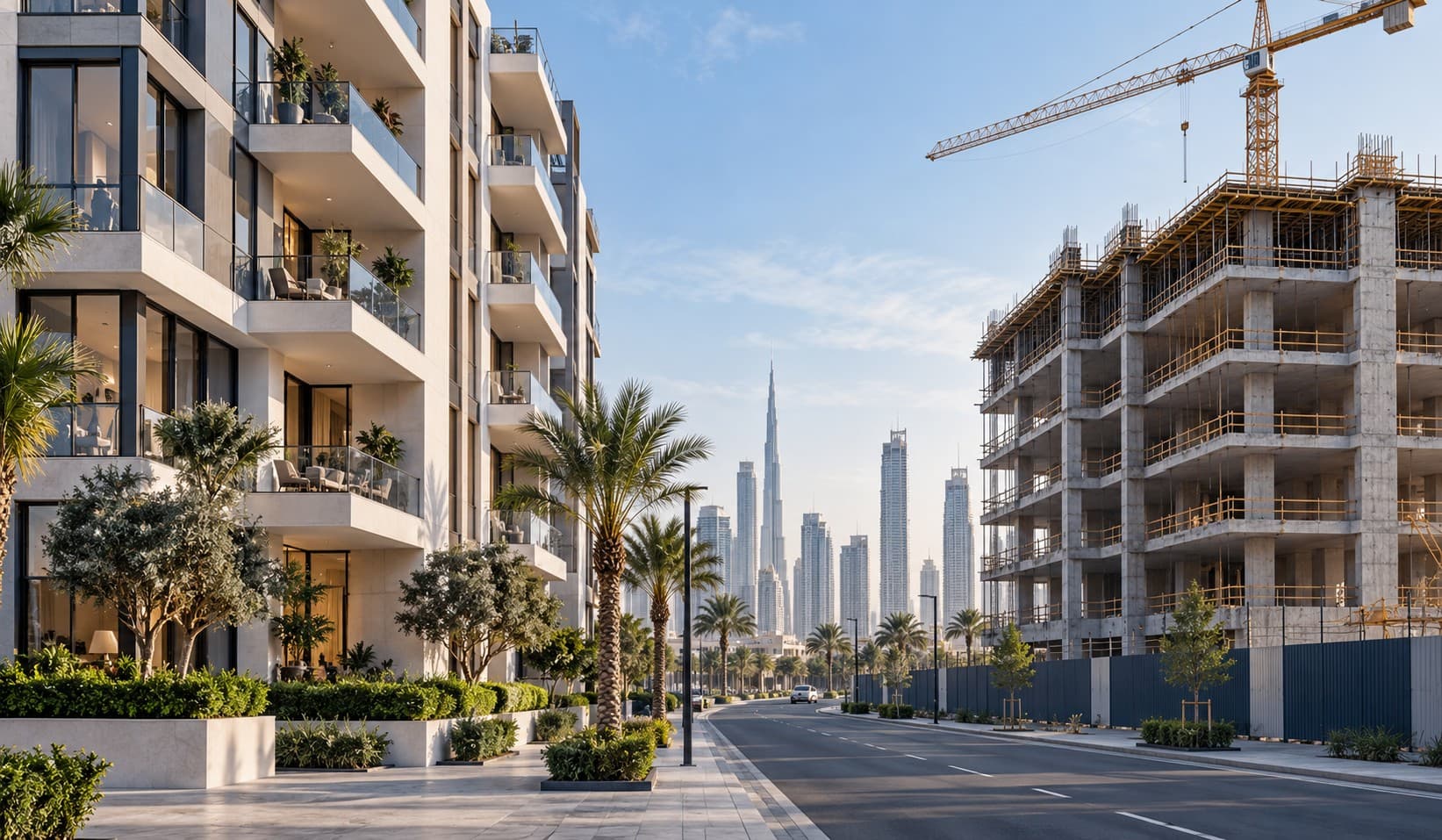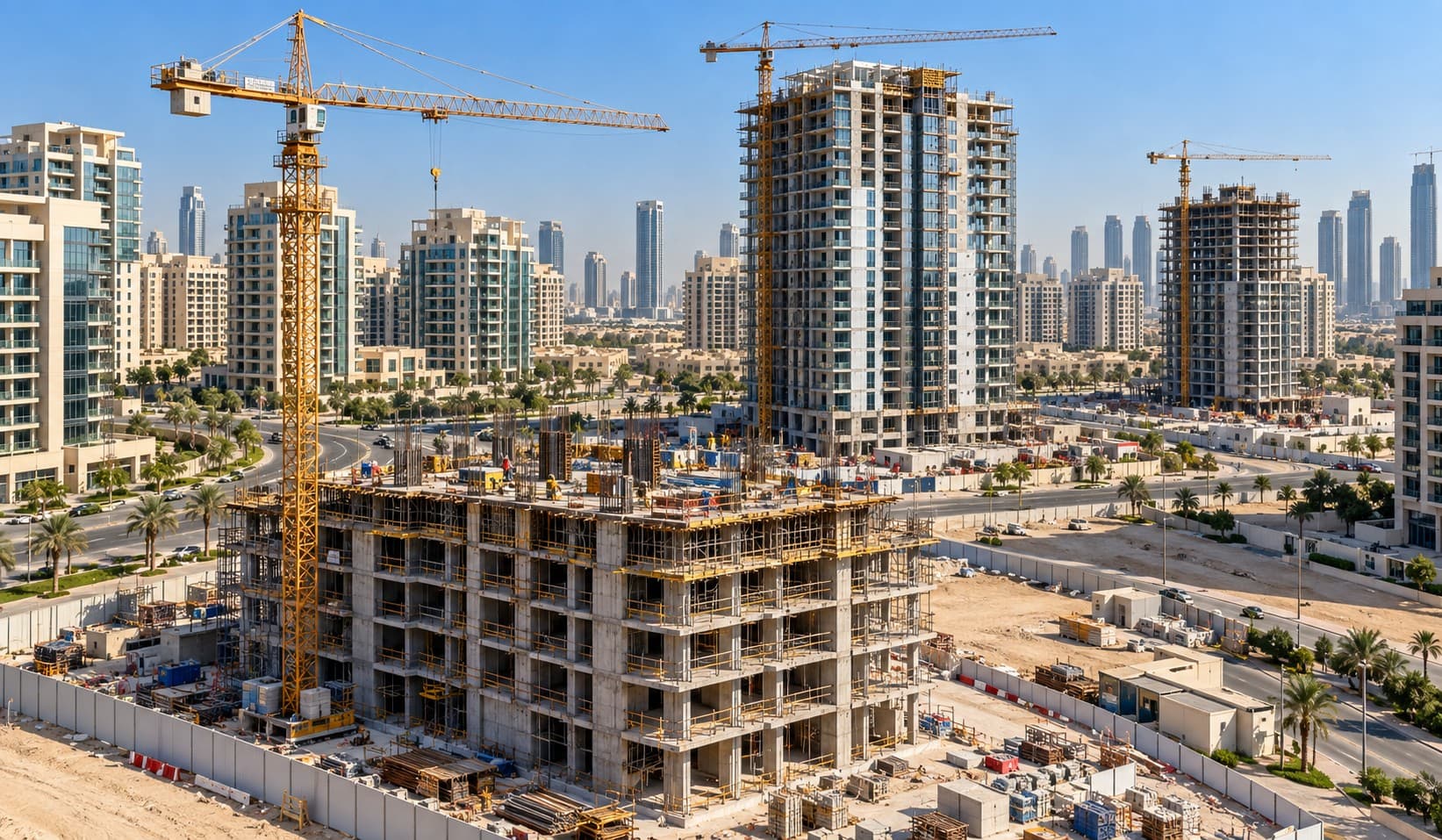
Dubai’s 2026 housing pipeline is substantial. A fäm Properties analysis reported by Gulf News on 21 August listed 96,585 homes scheduled for handover in 2026 and 564,072 under construction. Separately, Savills recorded annual declines of more than 10% in comparable new-lease apartment rents in Dubai Marina, Business Bay and Jumeirah Village Circle (JVC) in Q3 2026.
This guide distinguishes scheduled supply from completed homes, reviews selected community and rental data, and sets out four checks investors can use to assess competition around a property. The figures describe different periods and do not establish how much of any rental change was caused by new construction.
How many homes are being delivered in Dubai in 2026?
The August fäm Properties analysis listed 96,585 homes scheduled for handover in 2026, with 82.9% already sold. Separately, DLD reported 24,537 new real estate units delivered in H1 2026, up 36% year on year; that release does not explicitly identify every unit as residential. A September population report recorded an increase of 226,885 residents since the end of 2025. Population growth supports the demand context, but residents are not equivalent to households or additional homes required.
| Figure | Value and reporting period | Source |
|---|---|---|
| Homes scheduled for 2026 handover | 96,585; 82.9% sold (August report) | fäm Properties via Gulf News |
| Real estate units delivered in H1 2026 | 24,537; up 36% year on year | DLD official release |
| Homes under construction | 564,072; 75.5% sold (August report) | fäm Properties via Gulf News |
| New launches, Jan–Sep 2026 | About 50,000; down about 64% year on year | Savills |
| Homes scheduled for 2027–2030 | Around 525,000; future pipeline | Savills |
| Average rents, Q2 2026 | Down 2.6% year on year | CBRE |
| Dubai population, September reading | 4,807,185; up 226,885 from end-2025 | DDSE via Gulf News |
Fewer units were launched in January–September 2026 than a year earlier. These launches relate to the future pipeline. The next question is how many of this year’s scheduled homes will actually be delivered.
Why do Dubai handover estimates differ?
The August fäm Properties analysis lists scheduled 2026 handovers, while Savills’ Q3 report gives an approximate expectation for deliveries during the year. These figures have different reporting dates, coverage and methods. They should not be treated as one reconciled dataset, and their difference cannot be used to calculate the number of delayed homes.
| Source and report date | 2026 figure | Meaning |
|---|---|---|
| fäm Properties via Gulf News, August | 96,585 | Scheduled handovers |
| Savills, Q3 2026 report | About 75,000–85,000 | Approximate expected deliveries; not guaranteed |
Khaleej Times, citing Fitch, reported that about 56% of homes scheduled for completion during 2022–2024 were delivered within those years. This illustrates historical timing risk; it does not validate a particular 2026 forecast. Handovers add completed homes, while rental availability can also increase when existing properties enter the long-term rental market.
Which Dubai communities have notable scheduled supply in 2026?
Among the selected communities detailed in the August report, Business Bay has 16,938 apartments scheduled for 2026 handover, with 88.7% sold. Downtown Dubai, Palm Jumeirah and Jumeirah Lakes Towers (JLT) also have reported pipelines. The table reproduces selected DXBinteract figures reported by Gulf News; it is not a complete ranking of Dubai’s communities.
| Selected community | Scheduled 2026 homes | Sold share in August report |
|---|---|---|
| Business Bay (apartments) | 16,938 | 88.7% |
| Downtown Dubai (apartments) | 3,981 | 96.6% |
| Palm Jumeirah (apartments) | 2,397 | 93.5% |
| Jumeirah Lakes Towers | 2,324 | 92.8% |
A high sold share does not establish owner occupation. Some buyers may offer their homes for rent or resale. Assess rental availability, leasing time, achieved rents and competing resale listings together; none of these figures alone measures how much new supply has been occupied.
How are Dubai rents changing in 2026?
Savills’ Q3 2026 comparison covers new leases for comparable properties, matched by property type and bedroom configuration. It shows annual apartment-rent declines of 12.8% in Dubai Marina, 12.2% in Business Bay and 10.4% in JVC. These are not changes across all leases or renewals. Separately, CBRE’s citywide measure fell 2.6% year on year and 6.2% quarter on quarter in Q2 2026.
| Community | Property type | New-lease rent change, Q3 2026 vs Q3 2025 |
|---|---|---|
| Dubai Marina | Apartments | −12.8% |
| Business Bay | Apartments | −12.2% |
| Jumeirah Village Circle (JVC) | Apartments | −10.4% |
| Al Furjan | Apartments | −7.5% |
| Arabian Ranches 3 | Villas and townhouses | −15.0% |
| Damac Lagoons | Villas and townhouses | −13.4% |
Savills recorded about 181,900 rental transactions in Q3, up 16% from Q2 but broadly in line with Q3 2025; new leases represented 44% of activity. Its report describes early, uneven signs of rental stabilisation. CBRE also identifies softer occupier demand and the movement of former short-term rentals into the long-term market. New construction is therefore one part of the explanation for rental pressure.
How to assess new supply before you buy: four steps
Step 1: Separate launches, construction and handovers
Check the status of competing projects. DLD’s Project Status Enquiry shows the reported completion percentage when you search by project name, project number or land number. Separate future scheduled completions from homes available for occupation. Also consider existing homes newly offered for long-term rent, and compare matching periods and property categories.
Step 2: Identify the homes that will compete with yours
As a practical starting point, review projects within about 1 km, then include any building tenants would consider an alternative. This is an NIP screening approach, not an official market boundary. Match bedrooms, size, finish, parking and budget. Assess apartments and villas separately where both are relevant, and review individual phases in communities such as Dubai Hills Estate and Dubai Creek Harbour.
Step 3: Read rents, prices and sales together
Registered sales show buying activity, not occupancy. Use DLD’s real estate transaction data for sales prices, and compare signed rents with asking rents. More comparable listings, longer leasing times, landlord incentives and lower achieved rents can indicate greater competition; review these signals together.
Step 4: Stress-test your holding period
Test your cash flow against the following illustrative scenarios before you commit. These are NIP planning assumptions, not market forecasts or official thresholds.
| Scenario | What to test |
|---|---|
| Handover six months late | Can you fund payments and costs without rental income? |
| Rent 10% lower | Does the property still cover service charges and finance? |
| Two extra months to rent | How much income do you lose in the first year? |
| More resales at exit | Will your unit still compare well on price and finish? |
Off-plan buyers carry more timing risk than buyers of completed homes. Our guide to off-plan vs ready property in Dubai compares the two in detail.
What does Dubai’s housing supply mean for investors?
The reported pipeline and rental changes vary by community and property type. Savills expects lower launch activity together with delayed completions to moderate near-term supply. Fewer launches mainly change the future pipeline; they do not immediately remove completed rental stock. Assess which homes compete with your property, when they may become available and how returns hold up if rents fall or deliveries slip.
This is NIP’s interpretation of the data, not a forecast.
Frequently asked questions: Dubai housing supply
Is Dubai heading for a housing oversupply in 2026?
There is no single answer for the whole city. DLD reported 36% growth in delivered real estate units in H1 2026, while Savills recorded about 64% fewer launches in January–September. September reporting also showed population growth. These measures cover different periods and cannot establish whether supply matches household demand. Review completed availability, leasing demand and comparable rents in the specific community.
What is the difference between a launch and a handover in Dubai?
A launch is when a developer starts selling a new project. A handover is when completed homes are delivered to buyers. Handovers add completed housing stock, but rental availability can also rise when existing homes enter the long-term rental market. Scheduled completion dates are not guaranteed handover dates.
How many homes are under construction in Dubai?
An August 2026 fäm Properties analysis reported by Gulf News listed 564,072 homes under construction, with 75.5% sold and most scheduled for handover by 2028. Separately, Savills reported a pipeline of around 525,000 homes scheduled for 2027–2030. These figures use different dates and coverage; they should not be added together or treated as guaranteed deliveries.
How fast is Dubai’s population growing in 2026?
A Gulf News report dated 29 September 2026, citing the Dubai Data and Statistics Establishment, recorded 4,807,185 residents, an increase of 226,885 from the end of 2025. This is a dated September reading, not a live population count. Digital Dubai separately reported an increase of around 332,000 residents during 2025.
How can I check a Dubai project’s construction progress?
Use the Dubai Land Department’s Project Status Enquiry service on its website, the Dubai REST app or WhatsApp. Search by project name, project number or land number to see the completion percentage. A high percentage shows progress but does not confirm a handover date.
Should I buy property in a Dubai area with a lot of new supply?
Assess the property’s price and rental prospects against comparable homes, including size, finish, service charges and expected competing supply. Check leasing times and test affordability under scenarios such as a 10% rent decline or a six-month handover delay. These are illustrative stress tests, not predictions or a recommendation to buy.
Check the competition before you buy
Tell us the community, property type and timeline you have in mind. Discuss competing supply, available rental evidence and recent transactions with NIP as part of your property assessment.
Research note: sources checked on 21 October 2026. Figures retain their original reporting periods and source attribution. Scheduled completions, approximate delivery forecasts and completed units are different measures. The sources are not a reconciled dataset, and the population figures are dated observations. Interpretations and stress tests are identified separately.
Important information: this article is for general information and does not constitute financial, legal, tax or investment advice. Property information and market conditions may change, and individual decisions require separate assessment.